
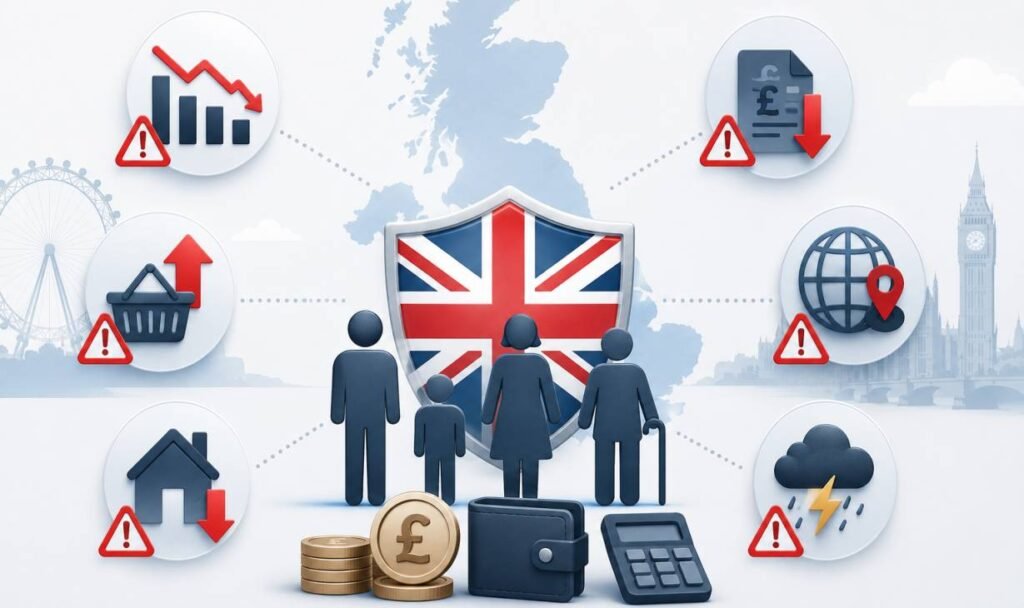

The Biggest Financial Risks Facing UK Investors in 2026: When people talk about investment risk, they usually picture a stock market crash. Sharp declines attract headlines, dominate financial news coverage, and often trigger emotional reactions from investors. Yet for many UK households, the biggest threat to long-term wealth in 2026 may not be a sudden market collapse at all.
A family can lose purchasing power through inflation without noticing it. A successful investment portfolio can generate respectable returns only for a significant portion of those gains to be reduced by taxation. A property owner can become exposed to inheritance tax simply because their home has appreciated in value over the past two decades.
These risks tend to develop slowly, which is precisely why they are often underestimated. For investors focused on preserving and growing wealth over the long term, understanding these challenges may prove more valuable than trying to predict the next market rally.
The Risk Many Investors Underestimate: Inflation’s Long-Term Impact
Inflation no longer dominates headlines in the way it did during the cost-of-living crisis, but that does not mean the problem has disappeared.
One of the biggest mistakes investors make is assuming that lower inflation automatically removes the threat. In reality, inflation continues to erode purchasing power every year it remains above zero.
Consider a saver with £100,000 held in low-interest accounts. If inflation averages 3% while savings earn less than that rate after tax, the real value of that money gradually declines. The loss may not feel dramatic in any single year, but over a decade the effect becomes significant.
For investors, inflation can also affect company profits, consumer spending, business investment decisions, and interest rate expectations. Even when markets perform reasonably well, inflation can reduce the real value of returns.
The challenge in 2026 is that many investors have become less concerned about inflation precisely when its cumulative impact remains substantial.
| Read More: UK Inheritance Tax Planning: What Families Need to Know in 2026 |
Frozen Tax Thresholds Are Quietly Increasing the Tax Burden
One of the most important financial stories of recent years has received far less attention than stock market movements. A number of tax thresholds remain frozen despite rising wages, property prices, and asset values. This process, commonly referred to as fiscal drag, means more people gradually move into higher tax brackets or lose valuable allowances without any formal increase in tax rates. For investors, the impact can be felt across several areas:
- Dividend income
- Capital gains
- Income tax exposure
- Inheritance tax planning
- Pension withdrawals
Many households focus on achieving higher investment returns while paying relatively little attention to how much of those returns will ultimately be retained after tax. The difference between a portfolio earning 7% before tax and one generating 7% after tax can become substantial over a twenty-year period.
Inheritance Tax Is No Longer Just a Concern for the Wealthy
For decades, inheritance tax was often viewed as an issue affecting only the very affluent. That assumption is becoming increasingly outdated.
The standard Inheritance Tax Nil Rate Band remains £325,000, while the Residence Nil Rate Band remains £175,000 for qualifying estates. At the same time, property values in many parts of the country remain significantly higher than they were when these thresholds were originally introduced.
A couple who purchased a family home in Surrey, Hertfordshire, Bristol, or parts of Greater London twenty years ago may now find that their property alone accounts for a large proportion of their estate.
Add workplace pensions, investment accounts, cash savings, and life insurance proceeds, and total estate values can quickly approach inheritance tax thresholds.
The issue is not necessarily that families have become dramatically wealthier. In many cases, asset inflation has simply outpaced tax allowances.
For investors with long-term wealth preservation goals, inheritance tax planning has become an increasingly important part of financial decision-making.
| Read More: UK Dividend Tax Changes 2026: Why Investors Are Paying Attention |
Diversification Matters Most When Investors Stop Paying Attention to It
Strong-performing investments have a habit of attracting more capital. When a particular sector performs well for several years, investors often become convinced that recent success will continue indefinitely. History suggests otherwise. One of the most common mistakes made by private investors is allowing a portfolio to become overly dependent on a single theme, sector, or asset class.
Examples include:
- Excessive exposure to technology stocks
- Heavy reliance on UK property
- Concentration in a handful of individual shares
- Overdependence on one geographic market
The problem with concentration risk is that it often feels comfortable while markets are rising. Diversification rarely attracts excitement because it is designed to reduce risk rather than maximise short-term gains. However, periods of market stress repeatedly demonstrate why spreading investments across multiple asset classes remains one of the most effective methods of managing uncertainty.
Property Investors Face a More Complex Environment
Property remains one of the UK’s favourite investments, but the landscape in 2026 is very different from the environment that existed during years of ultra-low interest rates.
Higher borrowing costs have changed affordability calculations for both homeowners and landlords. Investors must now pay closer attention to financing costs, rental yields, maintenance expenses, taxation, and local market conditions.
A property investment that appeared highly attractive when borrowing costs were lower may produce very different results when refinancing becomes necessary.
This does not mean property has lost its role within a diversified portfolio. Rather, it means investors should evaluate opportunities more carefully and avoid assuming that historic growth rates will automatically continue.
Holding Too Much Cash Has Its Own Risks
Periods of uncertainty often encourage investors to move money into cash. While cash plays an important role in emergency planning and short-term financial goals, holding excessive amounts for long periods can create a different problem.
Inflation steadily reduces purchasing power, even when nominal account balances remain unchanged. Many investors focus heavily on the risk of market declines while overlooking the risk of doing nothing. A portfolio that never experiences volatility may still fail to maintain purchasing power if returns consistently lag inflation. The objective is not necessarily to eliminate cash holdings but to understand the trade-off between stability and long-term growth.
Geopolitical Events Continue to Influence UK Markets
Investors do not need to follow every international headline, but global events can influence domestic portfolios more than many people realize. Energy prices, supply chains, trade relationships, commodity markets, and investor confidence can all be affected by developments occurring outside the UK.
Because these events are difficult to predict, attempting to position a portfolio around every geopolitical development is rarely practical. What investors can do is maintain a diversified strategy that is capable of withstanding periods of heightened uncertainty. The goal is resilience rather than prediction.
The Biggest Risks Facing UK Investors in 2026
| Risk | Potential Impact |
|---|---|
| Inflation | Erodes purchasing power and real investment returns |
| Fiscal Drag | Increases effective tax burdens over time |
| Inheritance Tax Exposure | More estates affected by frozen thresholds |
| Portfolio Concentration | Higher vulnerability to sector-specific downturns |
| Property Market Weakness | Reduced capital growth and profitability |
| Interest Rate Uncertainty | Affects borrowing costs and valuations |
| Excess Cash Holdings | Long-term loss of purchasing power |
| Geopolitical Events | Increased volatility and economic uncertainty |
A Real-World Example
Consider a couple living in Birmingham who have spent years building financial security. Their situation might look something like this:
| Asset | Estimated Value |
| Family Home | £550,000 |
| Stocks and Shares ISA | £120,000 |
| Investment Portfolio | £180,000 |
| Cash Savings | £50,000 |
| Workplace Pensions | £300,000 |
On paper, this family appears to be in a strong position. However, each of the risks discussed in this article could affect their long-term wealth. If inflation remains above the interest earned on cash savings, the real value of that money gradually declines. If investment gains are realized outside tax-efficient accounts, future tax liabilities may reduce overall returns. Rising property values may also bring inheritance tax planning into sharper focus.
Importantly, none of these risks involve a stock market crash. They are examples of how wealth can be affected gradually over time.
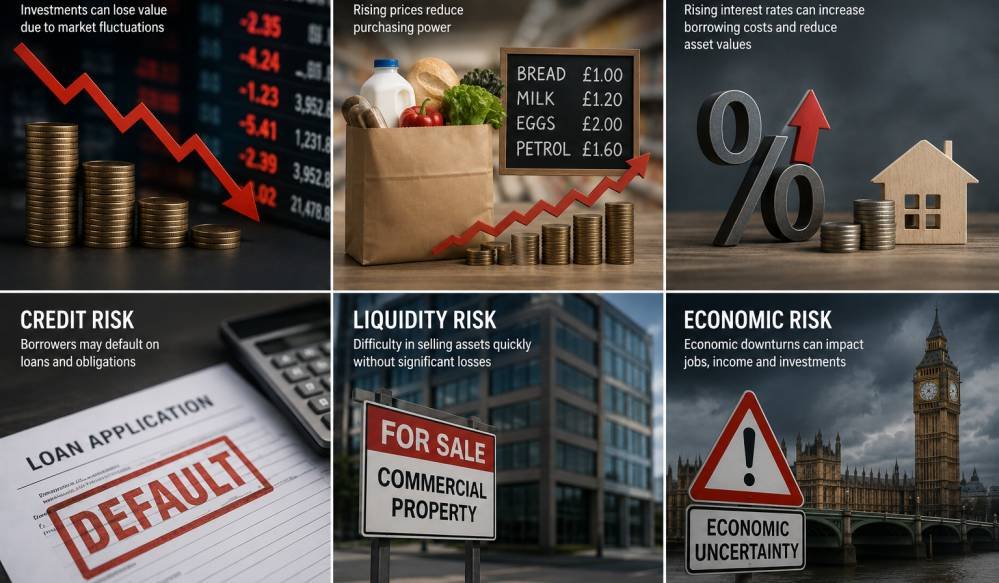
What Investors Can Do in Response
No investor can remove risk completely, but several practical actions may improve financial resilience.
| Action | Why It Matters |
| Review portfolio diversification | Reduces dependence on a single asset or sector |
| Understand tax exposure | Helps improve after-tax returns |
| Monitor inheritance tax position | Prevents unexpected estate-planning issues |
| Maintain emergency savings | Provides flexibility during market downturns |
| Review borrowing arrangements | Reduces refinancing risk |
| Focus on long-term goals | Helps avoid emotional decision-making |
Wrapping-up
The biggest financial risks facing UK investors in 2026 are not necessarily the risks that dominate newspaper headlines. Inflation, taxation, inheritance tax exposure, poor diversification, and excessive cash holdings can all reduce long-term wealth without creating the dramatic market events that attract widespread attention.
Investors who focus solely on market performance may overlook the quieter forces that gradually erode wealth over time. In many cases, successful investing is less about finding the next winning asset and more about recognizing the risks that can quietly undermine financial progress over the years ahead.
FAQ’s on The Biggest Financial Risks Facing UK Investors in 2026
What is the biggest financial risk facing UK investors in 2026?
There is no single answer, but inflation, fiscal drag, taxation, and poor diversification are among the most significant long-term risks.
Why is inflation still important if it has fallen from previous highs?
Even moderate inflation reduces purchasing power over time and can significantly affect long-term wealth accumulation.
Are more families paying inheritance tax?
Rising asset values combined with frozen inheritance tax thresholds mean more estates are becoming exposed to inheritance tax.
Why is diversification important in uncertain markets?
Diversification helps reduce reliance on any single investment, sector, or asset class and may limit the impact of unexpected downturns.
Disclaimer
This article is for informational purposes only and does not constitute financial, tax, or investment advice. Individual circumstances differ, and professional advice should be obtained where appropriate.
Official Sources
- Bank of England – https://www.bankofengland.co.uk
- HM Revenue & Customs (HMRC) – https://www.gov.uk/government/organisations/hm-revenue-customs
- HM Treasury – https://www.gov.uk/government/organisations/hm-treasury
- Office for National Statistics (ONS) – https://www.ons.gov.uk
- Financial Conduct Authority (FCA) – https://www.fca.org.uk