


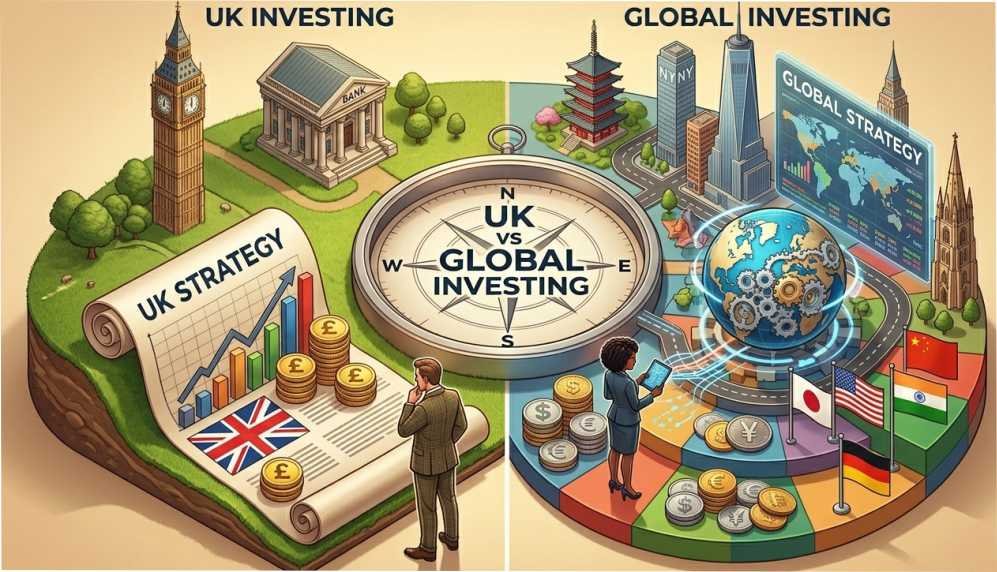
UK vs Global Investing: High-net-worth investors in 2026 are dealing with a changed and more complicated investment environment. With interest rates changing frequently, geopolitical tensions that are tense and evolving tax regulations, investing their large amount of capital is difficult; they do not know if they should keep their capital in the UK or invest in other global markets; therefore, they need to have a balanced strategy when it comes to where and when to invest their larger wealth. Both of these investing methods present investment opportunities, but each will have some new risks involved.
Should investors keep more capital in the UK or diversify globally?
The answer is rarely one or the other. Successful investors typically maintain a middle ground, leveraging both the safety of domestic investments and the potential for returns offered by international investments.
Our guide discusses the pros, cons, and strategy of UK investments vs. global investments in 2026 and helps HNW investors craft an investment plan for the future.
Important note: This article is purely for informational purposes and should not be construed as financial, tax, or investment advice. Values of investment products may go up and down, and historical performance is no guarantee of future results. Investors are encouraged to seek guidance from professional financial planners when investing.
Understanding the Investment Landscape in 2026
In 2026, the overall economy will be affected by the gradual slowing of growth rates in developed countries, the increasing number of new products coming on the market by emerging countries and sustained increases in prices across the globe. The UK’s economy is continuing to adjust as it comes out of Brexit, adjusting to new laws and regulations after Brexit and has started placing more focus on sectors that were traditionally within its borders.
For those with a high amount of capital invested, diversification, tax efficiency and long-term returns will be top of their mind when investing. The comparison between investing in the UK vs investing internationally is now based on how much of a role each will have in the overall portfolio rather than if you want to choose one over the other.
Why Consider UK Investments?
Tax Efficiency and Incentives: The UK continues to offer attractive tax-efficient investment vehicles such as ISAs, Venture Capital Trusts (VCTs), and the Enterprise Investment Scheme (EIS). These options can significantly reduce income tax and capital gains tax liabilities, making them especially appealing for investors with large capital.
Strong Legal and Regulatory Framework: The UK is known for its transparent financial system and investor protections. This stability is particularly valuable during uncertain global conditions, offering reassurance for capital preservation.
Opportunities in Emerging UK Sectors: Despite slower economic growth, certain UK sectors are thriving in 2026:
- Green energy and sustainability
- Fintech and digital banking
- Artificial intelligence and cybersecurity
Investing domestically allows investors to tap into these high-growth areas while benefiting from local market knowledge.
Currency Advantage for UK-Based Investors: For UK residents, investing locally reduces exposure to currency volatility. This can help stabilize returns, especially during periods of global forex fluctuations.
UK vs Global Investing: The core difference
| Factor | UK Investing | Global Investing |
|---|---|---|
| Market valuation | UK equities trade at a discount and are often seen as undervalued. | Global markets include a mix of expensive and attractively valued regions, depending on country and sector. |
| Return potential | More modest upside, but with stronger income characteristics in many cases. | Higher growth potential, especially in emerging markets, US smaller caps, and selected European markets. |
| Dividend income | Typically stronger dividend yields than US equities, which can suit income-focused portfolios. | Dividend levels vary widely by region, so income is less predictable across the whole global basket. |
| Currency exposure | Heavily tied to sterling, though many FTSE 100 firms earn revenue overseas . | Better currency diversification across USD, EUR, and other markets, which can reduce single-currency risk . |
| Sector mix | Strong in financials, energy, consumer goods, and other mature sectors . | Wider access to technology, healthcare innovation, semiconductors, green energy, and other growth sectors. |
| Risk profile | Lower volatility than many growth-heavy markets, but still exposed to UK-specific economic and policy risks. | More diversified, but introduces geopolitical, currency, and cross-border regulatory risk. |
| Best fit | Investors wanting value, income, and a home-market anchor | Investors prioritizing growth, diversification, and access to faster-expanding economies |
Major Risks Investors Should Monitor in 2026
Every investment strategy involves risk.
High-net-worth investors should pay particular attention to the following factors.
| Risk | Potential Impact |
| Inflation | Reduces purchasing power and real returns |
| Interest Rate Changes | Affects bonds, property, and equity valuations |
| Geopolitical Tensions | Creates market volatility |
| Currency Fluctuations | Influences international investment returns |
| Regulatory Changes | May affect taxation and compliance requirements |
| Economic Slowdowns | Can reduce corporate earnings and market performance |
| Liquidity Constraints | Particularly relevant for private investments |
| Concentration Risk | Overexposure to one country or sector |
Understanding these risks is often more important than attempting to predict short-term market movements.
Where Should High Capital Go in 2026?
High capital in 2026 should be spread across stable, growing, and diversified assets rather than put in one place. As a foundation, conservative investors should hold a core of value-oriented investments like large-cap stocks and high-quality bonds that generate good regular income and have lower volatility than other securities. After establishing your core holdings, you can diversify into higher risk growth investments by adding a growth satellite allocation consisting of investments in artificial intelligence, technology, renewable energy, and selected emerging market equities.
If you have a considerable amount of investable capital, you may also consider using a portion of your portfolio to invest in private investments to increase your potential return on investment and provide additional diversification away from publicly traded investments. In addition, you should look for global diversification opportunities through investing in safe haven jurisdictions, e.g. Singapore and the UAE, to reduce currency and geopolitical risk while maximizing your return on investment.
Finally, a portion of your portfolio should be held in cash or cash equivalent instruments to capitalize on opportunity and manage tax liabilities. The specific allocation between core, satellite, and liquidity will vary depending on your risk tolerance, where you are a tax resident, and your investment objective.
Example Portfolio Allocations for 2026
The appropriate allocation depends on individual circumstances, objectives, and risk tolerance.
Conservative Investor
| Asset Class | Allocation |
| UK Equities | 25% |
| Global Equities | 25% |
| Bonds | 30% |
| Alternatives | 10% |
| Cash | 10% |
Balanced Investor
| Asset Class | Allocation |
| UK Equities | 20% |
| Global Equities | 45% |
| Bonds | 20% |
| Alternatives | 10% |
| Cash | 5% |
Growth-Oriented Investor
| Asset Class | Allocation |
| UK Equities | 15% |
| Global Equities | 55% |
| Private Markets | 15% |
| Alternatives | 10% |
| Cash | 5% |
These examples are illustrative only and should not be interpreted as personalised investment advice.
| Also Read: ISAs vs General Investment Accounts: Which is Better for High Capital? |
UK vs Global Investing in 2026: A Practical £1 Million Example
Many investors understand the importance of diversification, but they often struggle to translate theory into a practical investment strategy. Consider an investor with £1 million to invest in 2026 who wants a balance between capital preservation, income, and long-term growth.
| Asset Class | Allocation | Amount |
|---|---|---|
| UK Equities | 20% | £200,000 |
| Global Equities | 45% | £450,000 |
| Bonds | 15% | £150,000 |
| Private Markets | 10% | £100,000 |
| Alternatives | 5% | £50,000 |
| Cash | 5% | £50,000 |
This approach provides exposure to UK dividend-paying companies while also capturing growth opportunities from international markets, particularly in technology, healthcare, and emerging economies.
Which Markets Look Most Attractive in 2026?
| Market | Key Opportunity |
|---|---|
| UK | Undervalued dividend stocks |
| US | AI and technology leaders |
| Europe | Industrial and defence growth |
| India | Long-term economic expansion |
| Japan | Corporate governance reforms |
| Emerging Markets | Demographic growth |
Example: Investing £1 Million in 2026
| Asset | Allocation |
|---|---|
| UK Equities | £200,000 |
| Global Equities | £450,000 |
| Bonds | £150,000 |
| Alternatives | £100,000 |
| Cash | £100,000 |
How Often Should Investors Review Their Portfolio?
A common misconception is that successful investing requires constant trading. In reality, many professional wealth managers recommend reviewing portfolios quarterly and conducting a more comprehensive annual assessment.
Regular reviews help investors:
- Maintain target allocations
- Manage risk exposure
- Respond to tax changes
- Capture new investment opportunities
- Adjust to changing financial goals
Common Mistakes HNW Investors Make
- Home-country bias
- Overexposure to property
- Chasing trends
- Ignoring currency risk
- Poor tax planning
Expert Insight: The Way Forward
High-capital investors heading into 2026 should think globally but act strategically. Even though the UK is still a safe, reliable market, the strongest performing portfolios will be created via domestic investment strength and international diversification. The ultimate objective is to successfully navigate both domains using flexible asset allocation, proactive tax strategy, and timely repositioning based on global economic and political developments.
Key Trends Shaping Investment Decisions in 2026
Several global trends are likely to influence investment returns over the coming years:
Artificial Intelligence Expansion
AI continues to drive investment across software, cloud computing, cybersecurity, and automation. Many of the world’s leading AI companies are listed outside the UK, making global exposure increasingly important.
Energy Transition
Governments and corporations continue investing heavily in renewable energy, battery storage, and energy infrastructure. Investors may find opportunities in both UK-listed companies and international markets.
Higher Government Debt
Many developed economies are managing elevated debt levels, which could influence taxation, interest rates, and economic growth over the long term.
Geopolitical Uncertainty
Trade disputes, regional conflicts, and supply-chain restructuring remain key risks. Diversification across multiple countries can help reduce the impact of any single geopolitical event.
UK vs Global Investing: Final Takeaway
Evidence indicates that, in 2026, neither a UK or world-only strategy will suffice for many high-net-worth investors. The UK offers appealing valuations and income, as well as tax benefits, but investing in world assets offers exposure to growth opportunities and increased diversification. A combination of UK and world assets should therefore create the necessary balance to maintain purchasing power and invest for growth in a global world that looks more uncertain now than it has for decades.
FAQ’s on UK vs Global Investing
Where do you think high capital should go in 2026?
You should spread your money across markets that are anchored in value, global equities, bonds, and have some in private assets for both growth and diversification.
UK vs Global Investing: which is better?
You can find more stability and income from the UK and greater growth and diversity from global markets. Typically a mix will give you the best return for high capital investment.
How much should I hold in cash?
You should hold enough cash for emergencies, taxes, and/or opportunities. This will usually comprise 10%-20% of your total liquid investments depending on your risk profile and individual goals.
Should I invest in private assets?
Yes, if you can accept the lack of liquidity. An allocation of 10%-20% in private equity, venture capital, or real estate/infrastructure can significantly increase your return on investment over the long run.
Sources
- HM Revenue & Customs (HMRC) – Tax rules, ISAs, EIS, and VCTs.
- Bank of England – Interest rates, inflation, and economic data.
- Office for National Statistics (ONS) – UK economic and investment statistics.
- Financial Conduct Authority (FCA) – Investor protection and financial regulation.
- International Monetary Fund (IMF) – Global economic outlook and market trends.
- Organisation for Economic Co-operation and Development (OECD) – International economic forecasts and research.
Author’s Note: This article is intended for informational purposes only. Tax rules, investment regulations, and economic conditions can change. Investors should seek independent financial, tax, and legal advice before making investment decisions.