
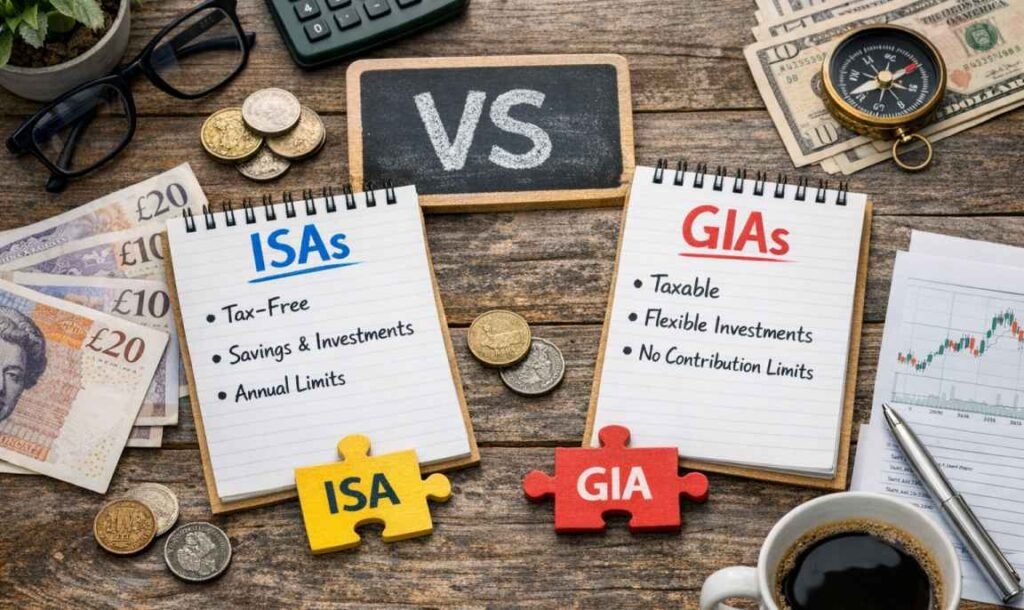

ISAs vs General Investment Accounts: Investors looking to allocate a significant amount of money will have to decide whether an Individual Savings Account (ISA) or a General Investment Account (GIA) will be the most tax effective way of building wealth. To put it simply, if you have funds to invest that are less than £20,000, then you will normally invest that in an ISA tax free to You because it is less than £20,000 and it has not reached your ISA limit for that financial year. However, for high-net-worth individuals who have reached their ISA limits, they can consider using a GIA as an alternative means of investing tax efficiently.
What are ISAs and GIAs?
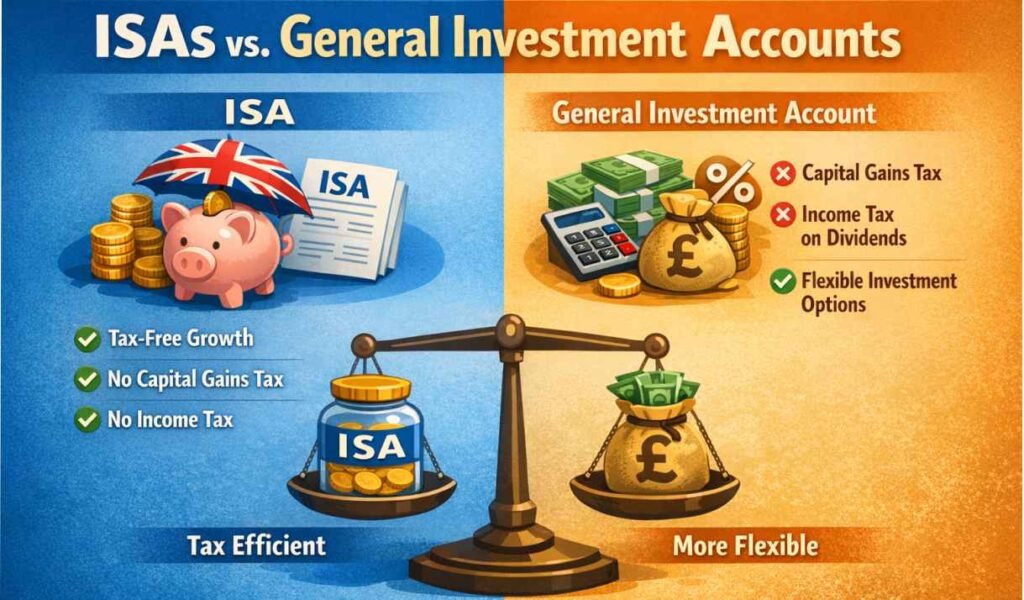
ISAs and GIAs are two common types of investment accounts in the UK, but they differ mainly in tax treatment and limits.
The ISA (Individual Savings Account) is a tax-free investment account registered with the UK government that allows you to hold up to £20,000 in total each tax year. You do not have to pay any form of income tax, dividend tax, or capital gains tax on all of the investments and gains made through your ISA account. This £20,000 limit will apply to all types of ISAs you have (cash, stocks and shares, lifetime, etc.) and for the same person.
GIAs (General Investment Accounts) are normal taxable brokerage accounts that allow you to invest as much as you like each year without a maximum contribution limit. All profits from an investment through a GIA are subject to all taxes (i.e., income tax, dividend tax, and capital gains tax) if they exceed your respective annual allowances.
ISAs vs General Investment Accounts: The Core Difference
| Feature | ISA (Individual Savings Account) | General Investment Account (GIA) |
|---|---|---|
| Tax treatment | Tax‑free: no income tax or capital gains tax on growth inside the ISA. | Taxable: income tax on dividends and capital gains tax on profits above annual allowances. |
| Annual contribution limit | £20,000 per tax year; unused allowance is lost. | No annual limit; you can invest any amount. |
| Best‑use focus | Protect new savings and high‑yielding assets from tax up to the cap. | Hold large or excess capital once ISA room is full. |
| Flexibility on assets | Limited to ISA‑eligible instruments (cash, selected funds, shares, bonds). | Broader range of assets, often including more complex or offshore products. |
| Core advantage | Tax‑efficient long‑term growth within the allowance. | Unrestricted investing, ideal for very high capital. |
Why Tax Efficiency Matters for Large Portfolios
When portfolios grow into six or seven figures, taxes can become one of the largest expenses affecting investment returns.
For example, two investors may achieve identical investment performance. However, the investor who legally minimizes taxes may retain significantly more wealth over a 10- to 20-year period.
This is why experienced investors often focus on both investment performance and tax efficiency.
A well-structured investment strategy seeks to:
- Reduce unnecessary taxes
- Maximise after-tax returns
- Preserve capital
- Improve long-term compounding
Which is Better for High Capital?
If you have large amounts of money to invest, you should view ISAs and GIAs as your partners instead of your competitors. The reason is that ISAs allow you to invest up to £20,000 per year, in a tax-free wrapper. So, you won’t have to pay any income tax or capital gains tax on any gains, dividends and interest you earn on your investments until you withdraw them from an ISA.
This means that, as a higher-rate taxpayer with a significant investment portfolio, ISAs are your most tax-efficient place to be when investing new money. Once you have reached your contribution limit for the tax year (or £20,000), then GIAs are the most appropriate investment vehicle for the remaining amount of capital you would like to grow and protect within your portfolio because they can hold unlimited amounts of money and be invested in whatever asset classes and currencies will best meet your investment objectives.
However, any dividends and capital gains earned on your investments held within a GIA are subject to taxes so you will need to plan around how to manage those distributions to stay within your annual allowances. To sum up, if you have significant amounts of capital to invest consider first using ISAs to provide you with some tax-protected investment capital; then continue investing your remaining capital in GIAs as a place to grow your investments and protect them from future taxes.
Example: Investing £100,000
Suppose an investor has £100,000 available to invest.
| Account Type | Amount Invested |
| Stocks & Shares ISA | £20,000 |
| GIA | £80,000 |
The ISA provides tax-free protection on the first £20,000 invested.
The remaining £80,000 can still be invested efficiently through a GIA while the investor gradually transfers assets into future ISA allowances over time.
Example: Investing £1 Million
For a £1 million portfolio:
| Account Type | Amount |
| Stocks & Shares ISA | £20,000 |
| GIA | £980,000 |
Although most of the portfolio initially sits within a GIA, the investor can continue using future ISA allowances each tax year.
Over many years, this strategy can gradually increase the percentage of wealth held within tax-free wrappers.
| Also Read: Real Estate vs Stock Market: Where Should You Invest Large Capital? |
Best Assets to Hold Inside an ISA
Because ISA gains are tax-free, many investors prioritise placing assets with the highest growth potential inside their ISA.
Examples include:
- Global equity funds
- Growth stocks
- Dividend-paying shares
- Technology-focused ETFs
- Emerging market funds
The greater the potential return, the greater the potential tax savings.
Best Assets to Hold Inside a GIA
Investors may consider holding more tax-efficient investments in a GIA, such as:
- Broad-market index funds
- Low-dividend growth shares
- Long-term buy-and-hold investments
- Tax-efficient ETFs
The goal is to reduce taxable distributions while maintaining investment growth.
Common ISA and GIA Mistakes
- Not Using the ISA Allowance Every Year
- Holding High-Dividend Investments Outside an ISA
- Ignoring Capital Gains Planning
- Believing a GIA Replaces an ISA
How to Use Both Together for Optimal Tax Efficiency
When investing for the long term using a high capital amount, the best way to achieve tax efficiency is to implement an “ISA-First and GIA-Second Strategy” and then adjust what types of assets will go in each wrapper.
This begins with using your ISA allowance to its maximum each year up to the maximum of £20,000 per individual before adding any additional funds into a GIA. In the ISA, you should focus on providing your account with growth-oriented and higher-yielding assets (e.g., global equity funds and/or dividend-paying stocks) so that as those assets compound over time, the compound interest will be free from income tax, dividend tax, or capital gains tax.
After your ISA has been filled to capacity, then you may utilize the GIA as your overflow account for most of your portfolio. In a GIA, you can still reduce taxes by holding other more tax-efficient assets (for instance, low dividend buy-and-hold equities) and by making full use of the £500 annual dividend allowance and the £3,000 annual capital gains tax allowance.
Who Should Prioritise an ISA?
An ISA may be particularly suitable if:
- You have unused ISA allowance.
- You are investing for the long term.
- You want tax-free growth.
- You are a higher-rate taxpayer.
- You wish to simplify tax reporting.
Who Should Prioritise a GIA?
A GIA may be more relevant if:
- Your ISA allowance is already fully used.
- You have large sums to invest.
- You require unlimited investment capacity.
- You want access to a wider range of investment opportunities.
Final Verdict
According to me the best move to maximize your capital has been to combine ISAs and GIAs in the same account. For the first £20,000 of each year’s contribution, use ISA accounts to invest in Growth or High Dividend funds. This allows you to grow the profits on your ISA investments without incurring taxes. Once your contributions to an ISA account have reached the maximum, you will use a GIA for any remaining contributions and keep your taxes to a minimum through making sure you are using your capital gains and dividend allowances correctly. Therefore, ISAs provide shelter to the most favorable part of your investments while GIAs provide a safe haven for the remaining funds.
FAQ’s on ISAs vs General Investment Accounts
Can I use both an ISA and a GIA at the same time?
Yes you can use both an ISA and a GIA at the same time.
ISAs vs General Investment: Which is better for a large lump sum?
If you are investing a large lump sum and it fits into your available ISA allowance, you should always use your ISA first and then move your lump sum into a GIA.
Can we transfer money from a GIA to an ISA?
You cannot directly transfer gains, although you can sell an investment in a GIA and repurchase the same investment inside an ISA, as long as that amount is within your annual ISA allowance.
Before using a GIA, should I always maximize my ISA?
Yes, as per my knowledge, whenever possible you should use the ISA first since it is the most tax-efficient strategy to increase your money.
Official Sources
- HM Revenue & Customs (HMRC): https://www.gov.uk/individual-savings-accounts
- HMRC Capital Gains Tax: https://www.gov.uk/capital-gains-tax
- HMRC Dividend Tax Guidance: https://www.gov.uk/tax-on-dividends
- Financial Conduct Authority (FCA): https://www.fca.org.uk/investsmart
Author’s Note
This article is for informational purposes only and should not be considered financial or tax advice. Investment rules and tax regulations can change over time. Always check the latest HMRC guidance or consult a qualified financial adviser before making investment decisions. Investing carries risks, and the value of investments can go up or down.