
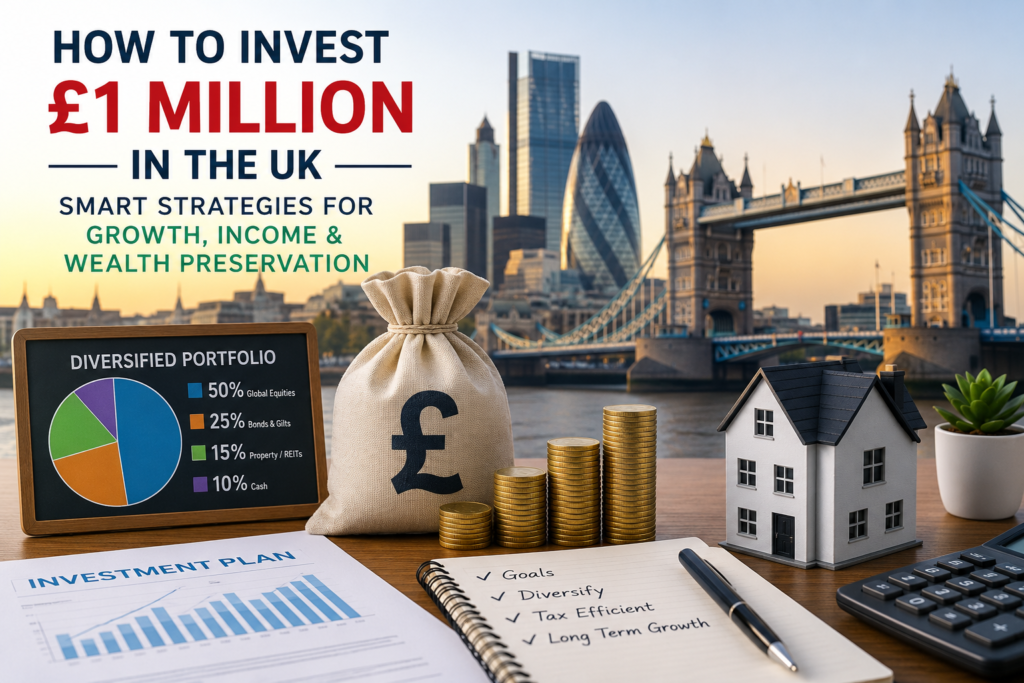

Invest £1 Million in the UK is a life changing event; however, it is not without its accountability. The source of your capital could be a business sale, an inheritance, property sale or years of investment funds; your handling of the investment capital can be a defining factor in your financial stability.
Many first-time high-net-worth investors make the mistake of obsessing over returns. Investing is not simply about generating riches. It is also about preserving your capital, minimizing your expenses, reducing your tax liability, and constructing an investment portfolio that will prosper for years to come.
In this guide, you will learn how to invest £1 million in the UK in 2026, including portfolio allocation strategies, tax-efficient investing, common mistakes to avoid, and practical examples..
Why Strategic Investment Matters in 2026
The importance of strategic investing in 2026 will be due to increased volatility from AI, energy transitions, and changes in society that will affect the global marketplace. Investors in the UK will struggle with low productivity growth and regional disparities, which make having a diversified portfolio necessary for outperforming in a time when interest rates are decreasing and equity opportunities are expanding. If there is no strategic approach taken, the opportunity to capitalize on the investment opportunities that exist in technology, renewables, and infrastructure will be missed, while the risk associated with market corrections will magnify potential losses.
Important: This article is for educational purposes only and should not be considered personal financial advice. Investment decisions should be based on your individual circumstances and risk tolerance.
Why Strategic Investing Matters in 2026
The investment landscape continues to evolve. Investors face changing interest rates, technological disruption, inflation concerns, geopolitical uncertainty, and shifting global economic trends.
For high-net-worth individuals, preserving wealth is just as important as growing it.
A well-diversified investment strategy can help:
- Generate long-term capital growth
- Produce regular income
- Reduce portfolio volatility
- Protect against inflation
- Minimise tax liabilities
- Support retirement and estate-planning goals
Rather than trying to predict market movements, successful investors focus on diversification and disciplined investing.
What Should You Do Before Investing £1 Million?
Before selecting investments, ask yourself three important questions:
1. What Is My Goal?
Your objective will influence every investment decision.
Common goals include:
- Long-term wealth growth
- Retirement income
- Capital preservation
- Funding children’s education
- Estate and inheritance planning
2. What Is My Risk Tolerance?
Can you tolerate a temporary 15–20% decline in your portfolio value?
Investors who can accept higher volatility may allocate more to equities, while conservative investors often prefer bonds and income-producing assets.
3. When Will I Need the Money?
Investment time horizon matters.
| Time Horizon | Suitable Investments |
|---|---|
| Less than 3 years | Cash, money market funds |
| 3–7 years | Bonds, balanced portfolios |
| 7+ years | Equities, global funds, property |
Best Way to Invest £1 Million in the UK
The best way to invest £1 million in the UK is through a diversified, tax-efficient portfolio across equities, bonds, property, and cash, using ISAs and pensions to minimize taxes. This approach balances growth, income, and risk while leveraging compounding over time.
Most financial planners recommend diversification across several asset classes.
Example Balanced Portfolio
| Asset Class | Allocation | Amount |
| Global Equities & ETFs | 50% | £500,000 |
| Bonds & Gilts | 25% | £250,000 |
| Property Funds & REITs | 15% | £150,000 |
| Cash & Money Market Funds | 10% | £100,000 |
This allocation aims to balance growth, income, and risk management.
Real-Life Portfolio Examples
Example 1: Investor Aged 40 Seeking Growth
A younger investor with a 20-year investment horizon may focus more heavily on growth assets.
| Asset Class | Amount |
| Global Equities | £600,000 |
| Bonds | £150,000 |
| Property Funds | £150,000 |
| Cash | £100,000 |
Objective: Maximum long-term growth.
Example 2: Investor Aged 65 Seeking Income
An investor approaching retirement may prefer a more balanced allocation.
| Asset Class | Amount |
| Global Equities | £400,000 |
| Bonds | £350,000 |
| Property Funds | £150,000 |
| Cash | £100,000 |
Objective: Income generation and capital preservation.
Use Tax-Efficient Accounts First
One of the easiest ways to improve returns is to reduce taxes.
Stocks and Shares ISA
The annual ISA allowance is currently £20,000 per person.
Benefits include:
- Tax-free capital gains
- Tax-free dividends
- Tax-free withdrawals
Couples can potentially invest £40,000 annually using both ISA allowances.
Self-Invested Personal Pension (SIPP)
A SIPP can provide valuable tax advantages.
Potential benefits include:
- Tax relief on contributions
- Tax-efficient growth
- Flexible retirement income options
Always check current contribution limits and eligibility rules.
Define Your Investment Goal
When considering a large sum of money like Invest £1 Million in the UK, it’s vital to define your investment goals. What would you like to achieve with your money? For example, are you hoping for the money to increase substantially over several years to provide a good retirement? Are you hoping to receive a consistent monthly income to help pay your bills now? Or are you trying to preserve your capital for some immediate purpose, like buying a house?
Younger investors may be able to invest in more volatile stock markets for the potential for greater long-term capital growth, while older investors typically prefer to invest in less volatile assets such as fixed income securities. Once you’ve settled on your investment goals, evaluate your risk tolerance would you be okay with experiencing market volatility and could you recover from it? OR are you totally risk-averse? Lastly, consider when the funds will be required to make appropriate investment choices, for example, dynamic capital investment in equities versus more steady capital investment in fixed income securities or cash.
Also Read: How to Invest in UK Artificial Intelligence Startups: A Guide For 2026
Make clearly defined investment goals, such as generating sufficient returns to fund your retirement or leaving an inheritance to your children, which will assist you in your decision-making process. Doing so will assist you in maintaining a proper mindset during periods of market volatility and will also help you to properly utilize tax-advantaged accounts while constructing a diversified portfolio tailored to your specific needs. Additionally, be sure to periodically review your investment goals in light of your changing personal circumstances or any changes to the law that affect investing.
Should You Invest in Property?
Property remains popular among UK investors, but direct ownership is not the only option.
Real Estate Investment Trusts (REITs)
REITs provide:
- Exposure to property markets
- Dividend income potential
- Greater liquidity than physical property
- No landlord responsibilities
For many investors, REITs offer a practical way to gain property exposure without managing tenants or maintenance costs.
The Role of Bonds
Bonds help provide stability when stock markets become volatile.
Benefits include:
- Regular income
- Lower volatility
- Capital preservation
- Diversification
Government gilts and high-quality corporate bonds can play an important role in a £1 million portfolio.
Keep a Cash Reserve
Holding some cash may seem unexciting, but it serves an important purpose.
Cash can:
- Cover emergencies
- Provide investment opportunities during market downturns
- Reduce the need to sell assets at unfavourable times
Many advisers recommend holding six to twelve months of expected expenses in cash or near-cash investments.
Tax Considerations for High-Net-Worth Investors
Investing successfully is not just about returns.
Taxes can significantly affect long-term wealth.
Potential taxes include:
| Tax Type | May Apply To |
| Capital Gains Tax | Investment profits outside tax wrappers |
| Dividend Tax | Dividend income |
| Income Tax | Interest and pension income |
| Inheritance Tax | Estates above applicable thresholds |
Using ISAs and pensions can help reduce tax liabilities.
2026 Market Considerations
The UK will be facing slow growth at around 1% in 2026, high unemployment levels, and a cut to the Bank Base Rate to 3%. These factors combined with inflation easing creates a balanced opportunity and caution regarding a £1 million investment.
Furthermore, fiscal tightening, higher prices, centrifugal factors due to trade disputes are reducing the value of your UK assets so investing globally is more advantageous to creating wealth than an investment that would have a local bias. Labor weakness is creating an environment of growth in defensive sectors such as defence, worldwide investments in net zero policies are creating investment opportunities into renewable and green infrastructure supported through investments by the national wealth fund.
Structuring your investments in international ETFs, bonds, and sustainable REITs will help facilitate the anticipated rebound in the global marketplace. Structure your investments through market volatility over time will help to optimise the performance of your portfolio, therefore developing a strategically diversified portfolio will outperform attempting to chase undervalued stocks in the UK.
Common £1 Million Investment Mistakes
Avoid these costly errors:
- Putting Everything Into Property
- Holding Too Much Cash
- Chasing Investment Trends
- Trying to Time the Market
- Ignoring Fees
Final Words
If you want to Invest £1 Million in the UK, think clearly about goals, diversification and being tax smart. Spread your investments between global equities, fixed income, property funds and cash while using ISAs and/or SIPPs to shelter your growth. Do not place all of your eggs into one basket, for example property alone.
Gradually increase your market exposure, continually look at your portfolio annually and consult a good adviser to find a way that works for you. Remember, patience is better than panicking, this balanced strategy will enable you to create a legacy that can support you through both up and down cycles of the market. Get started now to reap the rewards of your efforts going forward.
FAQ’s on Invest £1 Million in the UK
What is the ideal way to Invest £1 Million in the UK?
The optimal investment strategy for a Invest £1 Million in the UK is to spread it across global stocks (40-60%), bonds (20-30%), property funds (10-20%), and cash (5-10%) using tax-free ISAs and SIPPs. This balances growth, income, and safety.
How much ISA allowance do I have?
A Stocks and Shares ISA has an allowance of £20,000 per person each year; any gains from an ISA will not be taxed now or in the future. When two individuals are partnered, each of them can maximize their own allowance.
Should I invest in real estate with £1 million?
Use a real estate investment trust (REIT) or a real estate fund rather than directly purchasing rental property. These alternatives provide diversification, liquidity, and returns without managing a tenant.
What should I do first?
Make your goals (capital appreciation, current income, or capital preservation), place your funds in cash temporarily, and invest gradually (i.e., over 6 to 12 months).
Do I need a financial advisor?
Yes, as it will be of great benefit to your financial situation and future.
Author Note:
This article is for educational purposes only and does not constitute financial advice. Investors should consider their individual circumstances and consult a qualified financial adviser before making investment decisions.
Official Sources
- HMRC ISA Guidance: https://www.gov.uk/individual-savings-accounts
- HMRC Pension Tax Relief: https://www.gov.uk/tax-on-your-private-pension/pension-tax-relief
- Financial Conduct Authority (FCA): https://www.fca.org.uk/investsmart
- MoneyHelper: https://www.moneyhelper.org.uk
- Bank of England: https://www.bankofengland.co.uk