
Published: April 10, 2026
Last Updated: June 08, 2026
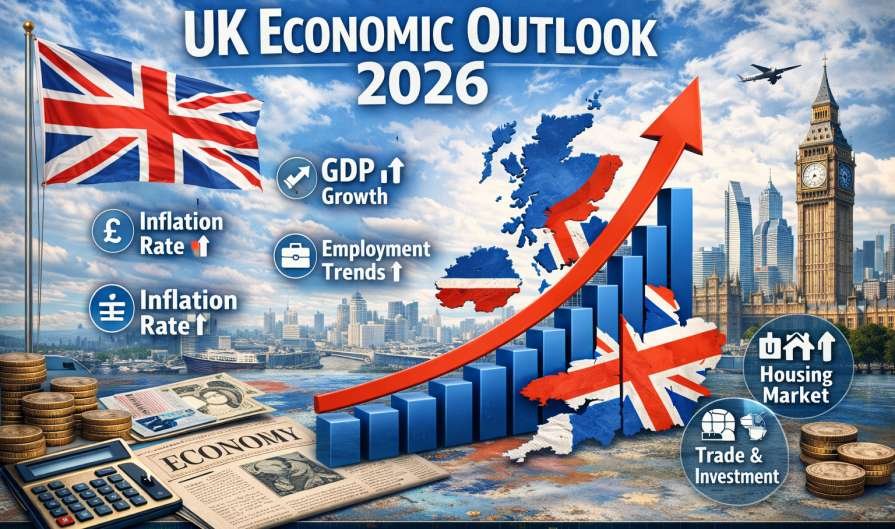
UK Economic Outlook 2026: The UK’s economic story in 2026 is not one of boom or recession. It is a story of adjustment. After several years dominated by inflation shocks, rising interest rates, energy-market disruptions, and geopolitical uncertainty, the economy is entering a period where investors are once again focusing on fundamentals rather than crisis management. Inflation is no longer the only headline. Attention is shifting back to productivity, corporate earnings, investment flows, and long-term growth potential.
That shift matters because investment opportunities often emerge when markets stop reacting to emergency conditions and begin pricing businesses based on their future cash flows. For investors, the key question is no longer whether the UK can avoid recession. The more important question is which sectors can grow in a low-growth economy and which assets can deliver returns if interest rates gradually move lower.
The UK Economy Is Growing, But Not Everywhere
One of the biggest mistakes investors make is treating the economy as a single entity. Economic growth rarely occurs evenly. In 2026, some areas of the economy are likely to expand while others continue to struggle. Consumer-facing businesses may benefit from improving household finances, while highly indebted sectors could remain under pressure. Technology-related investment is attracting capital, while parts of traditional manufacturing continue to face global competition and higher operating costs.
This uneven growth environment often creates opportunities because markets tend to focus on headline GDP figures while overlooking stronger trends developing beneath the surface.
For example, a business providing cybersecurity services to financial institutions faces a very different economic reality from a retailer dependent on discretionary consumer spending. Both operate within the same economy, yet their growth prospects may differ significantly.
Why Inflation Matters Less Than It Did Two Years Ago
For much of the previous economic cycle, inflation dominated every investment conversation. Rising prices influenced consumer behaviour, borrowing costs, wage negotiations, and corporate profitability. In 2026, inflation remains important, but investors are increasingly focusing on what comes next.
When inflation begins to stabilise, companies gain greater visibility over future costs. Businesses become more willing to invest, lenders become more confident, and consumers can make spending decisions without worrying that prices will increase dramatically within a few months.
Historically, markets have often performed better during periods when inflation is moderating than during periods when inflation is accelerating. That does not guarantee positive returns, but it changes the environment in which investment decisions are made.
| Do Read: UK vs Global Investing: Where Should High Capital Go in 2026? |
The Most Important Number Investors Should Watch
Many investors spend too much time watching stock prices and not enough time watching the Bank of England’s interest-rate decisions. Interest rates influence almost every asset class.
They affect mortgage payments, business borrowing costs, property valuations, bond prices, and equity valuations. A technology company planning expansion, a homeowner refinancing a mortgage, and a pension fund allocating capital are all affected by the same monetary policy decisions.
If borrowing costs gradually decline during 2026, the impact may not be felt immediately. However, lower financing costs can improve corporate profitability and support investment activity over time. This is why professional investors often pay close attention to monetary policy even when financial news headlines focus elsewhere.
3 Areas of the Economy Worth Monitoring
Artificial Intelligence and Business Productivity
The current AI investment cycle differs from previous technology booms because businesses are increasingly focused on measurable productivity improvements rather than experimental projects.
Law firms are automating document reviews. Financial institutions are improving fraud detection. Manufacturers are reducing downtime through predictive maintenance systems.
The investment opportunity is not necessarily limited to companies building AI systems. Businesses that successfully deploy these technologies may ultimately generate greater shareholder value.
Energy Infrastructure
The UK’s transition towards cleaner energy sources requires substantial investment in power generation, electricity transmission, battery storage, and supporting infrastructure.
These projects often operate on investment horizons measured in decades rather than quarters. For investors, that can create opportunities linked to long-term structural demand rather than short-term economic cycles.
Healthcare and Life Sciences
Healthcare demand is influenced by demographics as much as economics. An ageing population continues to increase demand for medical services, diagnostics, pharmaceuticals, and healthcare technology. While healthcare companies are not immune to economic pressures, their revenues are often less dependent on consumer confidence than many other industries.
What Experienced Investors Are Doing Differently
Many successful investors are approaching 2026 differently from how they approached the period immediately after the pandemic.
During years of exceptionally low interest rates, investors were often rewarded for taking greater risks because capital was cheap and growth was abundant.
Today’s environment is different. Profitability, balance-sheet strength, cash flow generation, and valuation discipline have become more important. Investors are paying closer attention to how companies earn money rather than simply how quickly they grow.
This shift explains why some mature businesses have outperformed expectations while certain high-growth companies have struggled despite strong revenue expansion.
A Realistic Portfolio Example
Consider 2 investors with same £500,000 portfolios.
Investor A places 80% of their capital into a single high-growth sector because they expect rapid returns.
Investor B spreads investments across global equities, UK shares, bonds, infrastructure assets, and cash reserves.
If the favoured sector experiences a correction, Investor A’s portfolio may suffer substantial losses. Investor B may still experience volatility, but diversification reduces dependence on a single economic outcome.
This example highlights an important reality: successful investing is often more about managing risk than predicting the future.
UK Economic Outlook 2026: Risks to Watch
| Risk Category | Detail | Impact on Investments |
|---|---|---|
| Inflation Surge | Energy shocks from geopolitical tensions push prices higher, delaying rate cuts | Erodes bond returns; favors real assets |
| Fiscal Strain | High public debt limits spending, raises borrowing costs | Widens gilt yields; pressures equities |
| Labor Weakness | Rising unemployment curbs consumer spending | Hits cyclical stocks; boosts defensives |
| Trade Barriers | US tariffs and Brexit frictions slow exports | Hurts manufacturing; aids domestic focus |
| Market Volatility | AI bubble risks and credit tightening | Increases portfolio drawdowns |
What Different Investors May Prioritise
| Investor Type | Primary Goal | Potential Focus Areas |
| Retiree | Income and capital preservation | Bonds, dividend shares, infrastructure |
| Balanced Investor | Growth and stability | Diversified equity and bond portfolio |
| Growth Investor | Long-term capital appreciation | Technology, healthcare, global equities |
| High-Net-Worth Investor | Tax efficiency and diversification | EIS, VCTs, private markets, global investments |
| Young Investor | Maximum long-term growth | Global equities and growth sectors |
What the Next Five Years Could Look Like
The most interesting investment question is not what happens in the next six months but what the economy may look like by the end of the decade.
If investment in technology, infrastructure, and productivity improvements continues, the UK could gradually strengthen its long-term growth potential. If productivity remains weak, economic growth may continue to lag behind historical averages.
For investors, this means focusing less on short-term forecasts and more on identifying businesses and sectors that can thrive under multiple economic scenarios.
Wrapping-up
The UK economic outlook for 2026 is more nuanced than either the optimists or pessimists suggest. The economy is not entering a period of explosive growth, but neither is it facing the extreme pressures that dominated recent years. Lower inflation, improving business confidence, technological investment, and infrastructure spending are creating opportunities, even as fiscal pressures and global uncertainty remain.
For investors, the challenge is not finding the next headline trend. It is understanding how economic changes influence corporate earnings, valuations, and long-term returns. Those who focus on quality assets, realistic expectations, and disciplined decision-making are likely to be better positioned than those chasing the latest market narrative.
FAQ’s on UK Economic Outlook 2026
Is it a good idea to invest in the UK in 2026?
Yes, 2026 can be a viable investment year for the UK; however, it is not well suited for aggressive, high-risk strategies. Growth expectations are stable with declining inflation; therefore, balanced long-term investments are preferred over short-term speculative/performance type strategies.
Should investors only invest in UK markets?
No, UK markets are expected to have relatively modest growth opportunities so therefore investors should seek to diversify globally. The US and some emerging markets may provide higher expected rates of return and higher potential growth.
Will bonds be a good investment in 2026?
Yes, with higher expected yields and potential for capital gains due to declining interest rates, bonds can be a very attractive investment for 2026. Bonds are a good choice for those investors that are focused on investors seeking stability and regular income.
How much cash should investors hold in 2026?
Holding around 5–10% in cash is a smart strategy for investors to maintain some liquidity to take advantage of strategic investment opportunities in the market without exposing their portfolio to unnecessary risk.
Official Sources
- Bank of England
- Office for Budget Responsibility (OBR)
- Office for National Statistics (ONS)
- HM Treasury
Investment Disclaimer
This article is for educational purposes only and does not constitute financial, tax, or investment advice. Investments can fall as well as rise in value, and past performance is not a reliable indicator of future results. Independent research and professional advice should always be considered before making investment decisions.