
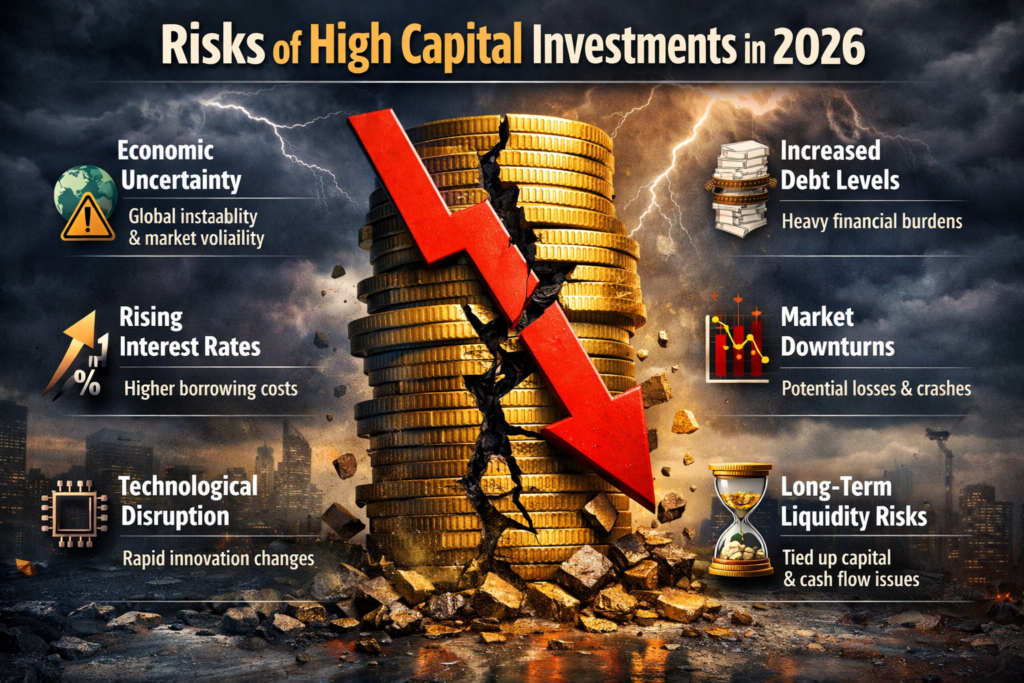

Risks of High Capital Investments in 2026: High capital investments can potentially generate high yield over the long run but at the same time involve a much higher degree of risk. As of 2026, individuals who choose to invest vast sums of money in, for instance, private equity, infrastructure, commercial real estate, renewable energy investments or various types of expansion within existing business pursuits will encounter.
Opportunities are still promising in areas like digital infrastructure, logistics, advanced manufacturing, or clean energy but risks now have become more dominant, given the increasing cost of finance, geopolitical risks, regulatory adjustments, and economic slowdown.
This guide highlights the primary risks to high capital investments within the UK in 2026, together with a practical guide for investors on how to safeguard their capital.
The Economic Backdrop of 2026
The UK entered 2026 amid mixed economic signals. Inflation is declining as compared to post-pandemic highs; however, borrowing remains at high levels because of the BoE’s conservative monetary policy. GDP is showing signs of modest recovery, yet general investor sentiment is dampened by ongoing, unstable global conditions like volatility in energy pricing and geopolitical tensions with major trading partners.
Due to this, the economic environment will have an immediate effect on capital intense ventures. When companies make multi-year commitments toward new factories, digital infrastructure, or real estate projects (including but not limited to residential properties), they must be mindful of how financing costs will affect their costs of doing business; possible delays in construction may result in additional costs, and the continued demand for consumers will create uncertainty regarding how long they will require products.
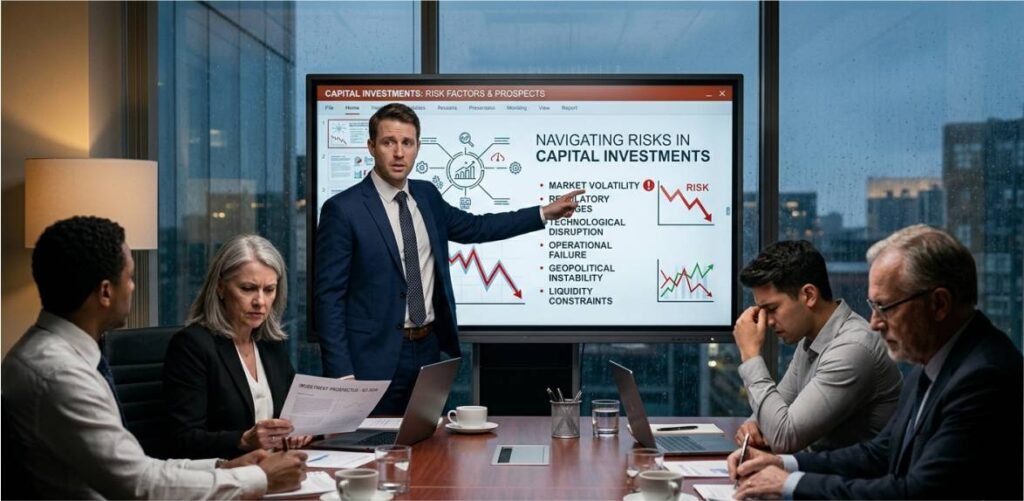
Risks of High Capital Investments in 2026
In 2026 there will be increased levels of risk associated with having made significant capital commitments to the UK due to the impacts of slower economic growth, AI hype cycle, gaps in regulation, geopolitical shocks and headwinds from government policies. These risks will affect liquidity, valuations and ultimately returns on such commitments for these illiquid, large scale investments.
- AI and Concerns Over Valuation: Cash is being poured into AI companies, and this is creating bubble fears because of the uncertainty of being able to receive a return on investment as well as the fact that the majority of the money has gone into a few established tech companies, which puts the investor at risk.
- Increasing Regulatory and Financial Pressures: The Bank of England has begun to investigate relationships between the banks and private companies given the high levels of debt this has caused, and they also continue to increase their scrutiny of high-risk financial instruments based on prior failures.
- Geopolitical and Policy Changes: Data suggest that tensions around the world are increasing and that is impacting the UK as it tries to evaluate its stability from the political upheaval across the globe.
- Walking a Tightrope: While inflation is starting to become more in line with targets, the central banks are still being overly cautious in their monetary policies. This is negatively impacting business earnings as consumers have reduced their spending.
Practical Example: Impact of Higher Interest Rates
Consider a commercial property project requiring £20 million in financing.
| Scenario | Borrowing Rate | Annual Interest Cost |
|---|---|---|
| Low-rate environment | 3% | £600,000 |
| Higher-rate environment | 6% | £1,200,000 |
The difference is £600,000 per year.
Over a five-year period, the project incurs an additional £3 million in financing costs, potentially reducing investor returns significantly.
| Also Read: Top 10 Financial Mistakes with Simple Fixes |
Strategies to Mitigate Investment Risk
To navigate these headwinds, as per my advise, investors and company’s can adopt several defensive strategies:
- Diversification: Spread investments over multiple industries and geographic areas to decrease the amount being at risk to one area.
- Scenario planning: Model ROI of each investment, given different levels of interest rates, inflation, and demand before you commit.
- Flexible financing structures: Consider multiple rounds of funding to provide more liquidity and/or convertible debt options to achieve liquidity.
- Policy monitoring and advocacy: Stay informed about and participate in consultation with the government on proposed initiatives so that you can address changes in regulation early.
- Sustainability alignment: Invest in long-term ESG–compliant projects that help meet the UK green transition goals and frequently receive government support and increasing investor interest.

Risk Assessment Example
Before committing capital to a large project, investors may evaluate multiple scenarios.
| Factor | Base Case | Stress Scenario |
|---|---|---|
| Interest Rate | 5% | 7% |
| Revenue Growth | 3% | 0% |
| Construction Cost Increase | 2% | 10% |
| Project Completion | On Schedule | 12 Months Delay |
This type of analysis helps identify vulnerabilities and prepare contingency plans.
Key Warning Signs Before Making a Large Investment
Investors should exercise caution if a project shows any of the following characteristics:
| Warning Sign | Potential Risk |
|---|---|
| Heavy reliance on debt | Rising financing costs |
| Optimistic revenue forecasts | Lower-than-expected returns |
| Regulatory uncertainty | Project delays |
| Limited liquidity | Difficulty exiting investment |
| Concentrated exposure to one sector | Increased volatility |
| Weak cybersecurity controls | Operational disruption |
Identifying these risks early can help investors avoid costly mistakes and improve long-term investment outcomes.
Future Outlook: Balancing Opportunity and Caution
Despite ongoing challenges, significant opportunities continue to exist in sectors such as renewable energy, digital infrastructure, logistics, advanced manufacturing, and essential public infrastructure. The major challenge will be timing and risk calibration; investing strategically when stability and scalability are more likely than speculative.
For each high capital investment, thorough due diligence and sensitivity analysis is required. As the UK continues to adapt to the changing global economy, prudent investors will seek to invest in projects which offer adaptability, sustainable benefits and protection from macroeconomic volatility.
Final Words
High-capital investments can generate substantial long-term returns, but 2026 requires disciplined risk management. Investors who combine diversification, thorough due diligence, prudent financing structures, and regular stress testing will be better positioned to protect capital while capturing growth opportunities in sectors such as renewable energy, digital infrastructure, logistics, and advanced manufacturing.
FAQ’s
What are the Risks for Large Investment in 2026?
Increased costs and minimum returns on projects are caused by high levels of interest rates, slow economic growth, and global supply chain disruptions.
Is UK growth strong enough for heavy investing?
The UK economy has not developed well enough and sluggish increase in GDP has resulted in a general fall-off of consumption and exports, and therefore capital expenditures will continue to be riskier.
Are there growing cyber risks to projects?
Yes, Cyber attacks top the list of concerns for businesses, especially with high digital or artificial intelligence investment.
How can i lower these risks?
Official Sources
- Bank of England
- Office for National Statistics (ONS)
- UK Government Infrastructure and Projects Authority
- Financial Conduct Authority (FCA)
- HM Treasury
Disclaimer
This article is for informational purposes only and does not constitute financial advice. Investors should consult a qualified financial advisor before making investment decisions.