

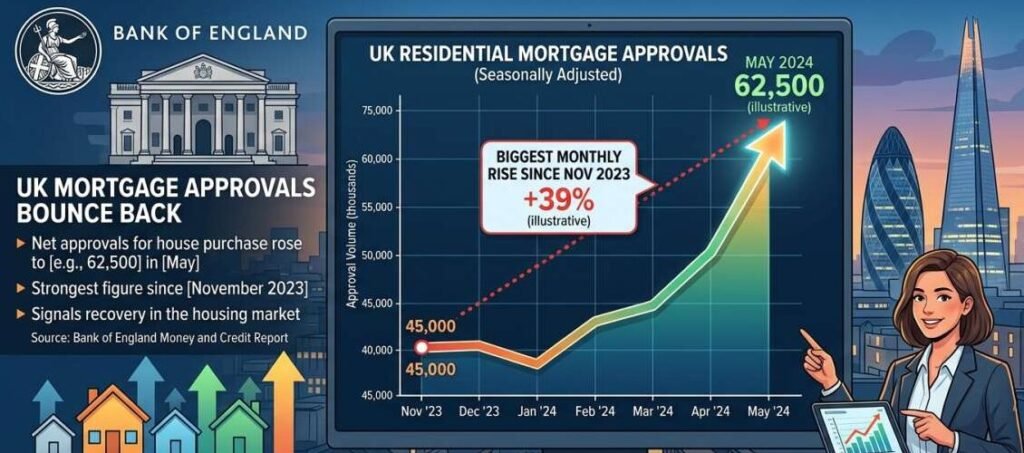
UK Mortgage Approvals 2026: The UK housing market received encouraging news after the latest mortgage lending figures showed a rebound in buyer activity during February 2026. According to data released by the Bank of England, mortgage approvals for house purchases increased to 62,584 in February, up from 60,200 in January.
The increase was stronger than many economists expected and suggests that lower mortgage rates and improving confidence are helping to support housing demand despite ongoing economic uncertainty.
While approval levels remain below long-term historical averages, the latest figures indicate that the housing market may be entering a period of gradual recovery after facing pressure from higher borrowing costs over the past two years.
What Are Mortgage Approvals?
Mortgage approvals measure the number of home loans approved by lenders before the money is actually borrowed. Because approvals are recorded before property purchases are completed, they are widely viewed as a leading indicator of future housing market activity.
When mortgage approvals rise, it often suggests that more people are entering the housing market. When approvals decline, it can indicate weaker demand or affordability challenges.
For economists, lenders, estate agents, and policymakers, mortgage approvals provide an early insight into the direction of the housing market.
UK Mortgage Approvals Surge to 62,584
The Bank of England reported that approvals for house purchases increased to 62,584 in February 2026 from a revised 60,200 in January. The rise represented the strongest monthly increase since late 2025 and exceeded market expectations. At the same time, remortgaging approvals also increased, suggesting that existing homeowners are continuing to refinance their mortgages as lenders compete for business. Net mortgage lending also strengthened during the month, indicating that overall borrowing activity remains resilient.
February 2026 Mortgage Market Snapshot
| Indicator | January 2026 | February 2026 |
|---|---|---|
| House Purchase Approvals | 60,200 | 62,584 |
| Remortgaging Approvals | 38,500 | 41,200 |
| Net Mortgage Lending | £4.2 billion | £4.8 billion |
The figures point to improving confidence among both homebuyers and homeowners.
Why Did Mortgage Approvals Increase?
Several factors appear to have contributed to the rise in approvals.
Lower Mortgage Rates
Mortgage rates have fallen significantly from the highs seen during the inflation and interest rate shock of 2023 and 2024.
Many lenders have introduced more competitive fixed-rate deals, improving affordability for buyers and encouraging previously hesitant households to enter the market.
Lower borrowing costs can reduce monthly repayments, making home ownership more accessible for first-time buyers and movers alike.
Greater Interest Rate Stability
The Bank of England has maintained a more stable interest rate environment compared with the aggressive rate increases seen in previous years.
As uncertainty around future borrowing costs decreases, consumers often feel more comfortable making long-term financial commitments such as purchasing a home.
Improved Consumer Confidence
A stable labour market and steady wage growth have helped support household confidence. Buyers who delayed purchasing decisions during periods of economic uncertainty may now be returning to the market.
Strong Household Savings
Bank of England data also showed continued growth in household deposits. Many households have accumulated savings over recent years, helping prospective buyers build larger deposits and improve mortgage affordability.
Impact of Bank of England interest rates on housing market
The Bank of England’s Bank Rate has a direct impact on mortgage pricing across the UK.
When interest rates rise:
- Mortgage repayments become more expensive.
- Borrowing affordability decreases.
- Housing demand often slows.
- House price growth tends to weaken.
When interest rates fall:
- Mortgage repayments become more affordable.
- Buyers can borrow more.
- Housing demand typically improves.
- Property transactions increase.
This relationship explains why mortgage approvals are often closely linked to changes in interest rate expectations.
Although lenders do not automatically match Bank Rate changes, movements in the base rate strongly influence the mortgage products available to consumers.
What This Means for Home Buyers in 2026
The latest mortgage approval figures are positive news for people planning to buy a home in 2026. Improving lending activity suggests that mortgage availability remains healthy and that lenders continue to compete for customers.
However, affordability challenges have not disappeared entirely. House prices remain elevated in many regions, and borrowers should carefully assess their financial position before committing to a mortgage.
Before Applying for a Mortgage
Prospective buyers should consider:
- Checking their credit score and credit report.
- Comparing offers from multiple lenders.
- Saving a larger deposit where possible.
- Understanding all homeownership costs beyond monthly repayments.
- Obtaining a mortgage agreement in principle before beginning a property search.
These steps can improve approval chances and help borrowers secure more competitive rates.
What About Remortgaging?
The increase in remortgaging approvals to 41,200 suggests many existing homeowners are taking advantage of improved mortgage deals.
Borrowers whose fixed-rate mortgages are due to expire may benefit from reviewing available options before automatically moving onto a lender’s standard variable rate.
Comparing rates early can potentially save thousands of pounds over the life of a mortgage.
Outlook for the UK Housing Market
Most housing market forecasts point toward modest growth rather than a rapid boom.
Industry forecasts suggest housing transactions may gradually improve during 2026 and 2027 if inflation continues to ease and borrowing costs remain stable.
Many analysts expect house prices to record moderate annual growth, supported by stronger affordability and improving buyer confidence.
However, risks remain, including:
- Inflation pressures.
- Global economic uncertainty.
- Labour market weakness.
- Future interest rate decisions.
These factors could influence housing demand and mortgage activity throughout the coming years.
Expert Perspective
The rise in mortgage approvals during February 2026 is an encouraging sign for the UK housing market. While approval levels remain below the long-term average recorded before the recent interest rate cycle, the data suggest that buyer demand is gradually recovering.
Rather than indicating a housing boom, the figures point to a more balanced market where affordability is improving and lending conditions are becoming more supportive. For buyers and homeowners, this creates opportunities, but careful financial planning remains essential.
Final Touch
The increase in UK mortgage approvals to 62,584 during February 2026 provides evidence that housing market activity is strengthening after a challenging period of higher borrowing costs.
Lower mortgage rates, improving consumer confidence, and stronger lending activity are helping support demand across the market. While challenges remain, the latest figures suggest that the UK housing sector is moving toward a more stable and sustainable recovery.
For homebuyers, homeowners, and property investors, mortgage approval data will remain an important indicator to watch throughout 2026 and beyond.
Frequently Asked Questions
What are mortgage approvals?
Mortgage approvals measure the number of home loan applications approved by lenders before funds are released to borrowers.
How many mortgage approvals were recorded in February 2026?
According to the Bank of England, there were 62,584 mortgage approvals for house purchases in February 2026.
Why did mortgage approvals increase?
Lower mortgage rates, improved consumer confidence, stronger household savings, and greater interest rate stability contributed to the increase.
Are mortgage approvals a good indicator of the housing market?
Yes. Mortgage approvals are considered a leading indicator because they often signal future housing transactions and market activity.
Will mortgage rates fall further in 2026?
Future mortgage rates will depend on inflation, economic conditions, and decisions made by the Bank of England. No future rate movements are guaranteed.
Official Sources
- Bank of England – Money and Credit Statistics
- Bank of England – Mortgage Lending and Household Finance Data
- Bank of England – Statistical Database
- UK Finance – Mortgage Market Forecasts and Reports
- Nationwide House Price Index
- HM Land Registry – UK House Price Index
- Office for National Statistics (ONS) – Housing Market Statistics
- UK Government – Stamp Duty Land Tax Guidance
Disclaimer: Mortgage approval figures, remortgaging approvals, and net mortgage lending data referenced in this article are based on the latest Bank of England Money and Credit statistics. Housing market forecasts and transaction projections are sourced from UK Finance and other recognised UK housing market data providers.